U.S. federal reference · effective for 2026
Seven tax constants for side-hustle planning
A compact, source-linked reference for calculations—not a tax estimate or personalized filing answer.
- Source period
- U.S. tax year 2026
- Sources accessed
- July 11, 2026
- Published rows
- 7 federal benchmarks
Illustrative arithmetic
$1,000 of simplified net profit produces a $141.30 self-employment-tax example.
The worksheet starts with $1,000 × 92.35% = $923.50. Below the Social Security limit, $923.50 × 15.3% = $141.30 after rounding. Income tax, Additional Medicare Tax, wages, deductions, credits, and other rules are outside this intentionally simplified example.
2026 benchmark table
| Metric | Published value | Illustrative example | How to interpret it |
|---|---|---|---|
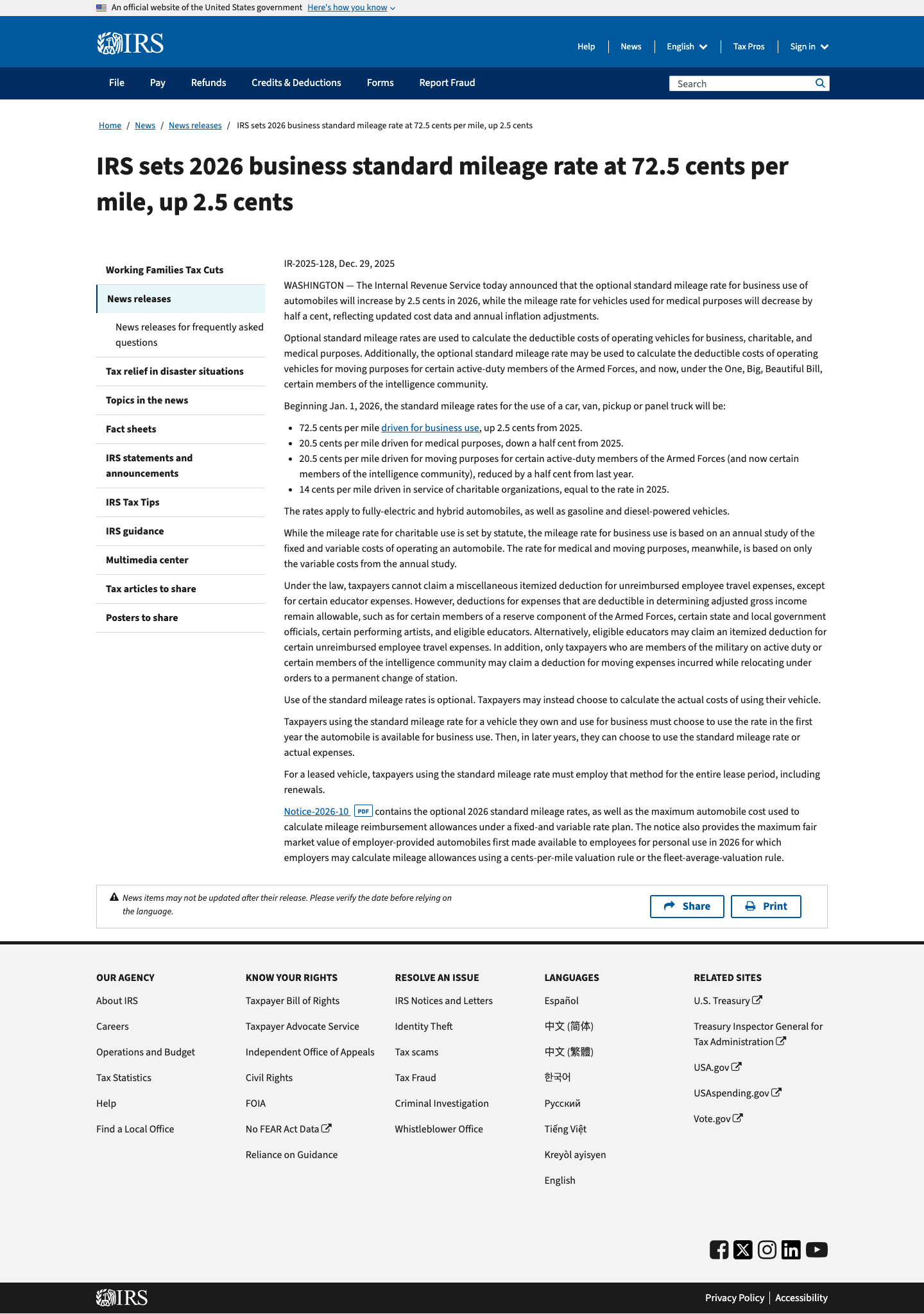
| Business standard mileage rate | $0.725 per business mile | 1,000 eligible business miles × $0.725 = $725 potential deduction | Optional method for eligible vehicle costs; it is a deduction, not a $725 refund. |
| Net-earnings multiplier for Schedule SE planning | 92.35% | $1,000 net profit × 0.9235 = $923.50 preliminary SE-tax base | The first step in the simplified self-employment tax worksheet. |
| Combined self-employment tax rate below the Social Security limit | 15.3% | $923.50 × 0.153 = $141.30 simplified SE-tax estimate | 12.4% Social Security plus 2.9% Medicare; income tax is separate. |
| General Schedule SE net-earnings trigger | $400 | If calculated net earnings are below $400, the standard worksheet says not to continue for SE tax. | This is net earnings, not gross revenue, and other filing requirements can still apply. |
| 2026 Social Security portion earnings limit | $184,500 | The 12.4% portion is limited by combined covered wages and net self-employment earnings. | The 2.9% Medicare portion is calculated separately and additional Medicare tax may apply. |
| Deduction for one-half of self-employment tax | 50% of calculated SE tax | $141.30 × 50% = $70.65 adjustment in the simplified example | An adjustment used when calculating AGI, not a dollar-for-dollar tax credit. |
| General estimated-tax planning threshold | $1,000 expected tax due | Run Form 1040-ES if expected tax due after withholding and refundable credits is at least $1,000. | A second safe-harbor test and special rules also apply; $1,000 alone is not the full test. |
Method
- 1
Limit the scope to federal constants that commonly affect U.S. sole-proprietor planning; do not attempt to encode a complete tax return.
- 2
Use the IRS 2026 mileage announcement and Notice 2026-10 for the optional business mileage rate.
- 3
Use the 2026 Publication 505 self-employment tax worksheet for the 92.35% multiplier, Social Security limit, tax components, and half-tax deduction.
- 4
Use current IRS topic and FAQ pages to qualify the $400 net-earnings and $1,000 estimated-tax planning thresholds.
- 5
Label every arithmetic result as an example, keep income tax separate, and recheck the live IRS documents before any annual refresh.
What the CSV contains
- • The human-readable metric and 2026 value.
- • The exact illustrative example printed on this page.
- • A short interpretation designed to prevent refund-versus-deduction or gross-versus-net confusion.
- • The controlling IRS source URL and access date.
Privacy note: these are public federal constants. No taxpayer return, account, income, or personally identifiable record was collected, so anonymization is not applicable.
Download the published data
Seven rows with value, worked example, interpretation, official IRS URL, tax year, and access date.
Official IRS sources
- 1.IRS sets 2026 business standard mileage rate at 72.5 cents per mile
Internal Revenue Service · accessed
- 2.Publication 505 (2026), Tax Withholding and Estimated Tax
Internal Revenue Service · accessed
- 3.Self-employed individuals tax center
Internal Revenue Service · accessed
- 4.Estimated tax FAQ for individuals
Internal Revenue Service · accessed
Limitations
- This is general educational information, not tax advice. It cannot determine filing status, deductions, credits, state or local tax, entity treatment, or payment obligations.
- The 15.3% shorthand consists of a 12.4% Social Security component and 2.9% Medicare component. The components do not always apply to the same full base, and Additional Medicare Tax may apply.
- The $1,000 estimated-tax value is only one part of a two-part federal test. Prior-year safe harbors, withholding, credits, income level, and special rules matter.
- The mileage rate is optional and subject to eligibility and method-selection rules. A deduction is not a dollar-for-dollar refund.
- IRS pages and forms can change. Use the tax-year form and instructions that apply to your facts or consult a qualified professional.